

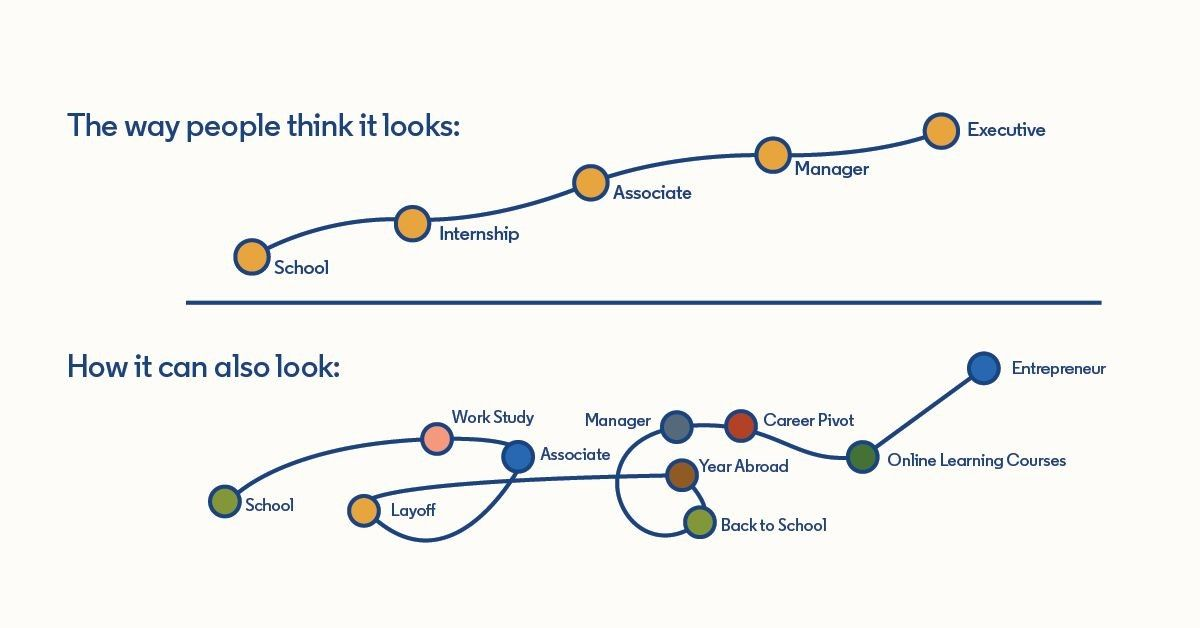
There's a career path that gets sold to people who work in tech.
It goes something like this: you pick a lane early, you develop expertise in that lane, you get promoted through that lane, and eventually you become a senior version of the thing you decided to be at 22. If you're ambitious, maybe you become a director or VP of that thing. If you're really ambitious, you go wide into general management. The narrative has clean handoffs. Each job explains the next one.
Most people I know in tech don't have that career. They just pretend they do when they're writing their LinkedIn summary.
The nonlinear career is actually the norm in this industry, not the exception. But because we tell the story backward, assembling a coherent arc out of genuinely messy decisions, we've collectively agreed to act like the zigzag was always part of the plan. That pretending has costs. It makes people who are in the middle of an unplanned transition feel like they're failing at something everyone else figured out. It makes career pivots feel like admissions of defeat instead of what they usually are: a response to new information about who you are and what you actually want.
I want to push back on the whole frame.
The myth isn't just a story. It's a filter.
When companies hire, they pattern-match. A resume that reads like a straight line is easier to evaluate than one that bends. Recruiters, hiring managers, even well-meaning mentors have been trained to look for a through-line, and if they can't find one quickly, they often move on.
This creates a practical problem for people with nonlinear histories: the career market rewards the appearance of intentionality even when real careers are shaped by luck, timing, relationship, and circumstance as much as deliberate strategy.
The result is a quiet pressure to retrofit your story. To make the detour sound like foresight. To describe the lateral move as "expanding your scope." To frame the period where you genuinely didn't know what you were doing as "exploring the intersection of X and Y." There's nothing wrong with narrative coherence. The problem is when the retrofitting goes so far that you lose touch with what actually happened and why, and you start believing your own revisionist history. Because that history will eventually steer you wrong. You'll make future decisions based on a self-concept that isn't entirely real.
The myth of the linear career doesn't just shape how we present ourselves. It shapes how we make decisions, what opportunities we let ourselves consider, and whether we give ourselves permission to change direction when the current path stops making sense.
The identity problem nobody talks about
Here's the thing about changing directions in your career that most advice skips: it's not primarily a strategic problem. It's an identity problem.
When you've spent years building expertise and reputation in a domain, that domain becomes part of how you understand yourself. Product manager. Engineer. Consultant. Marketing strategist. These aren't just job titles. They're answers to the question of who you are. So when you shift away from one, even voluntarily, even toward something genuinely better, there's a period of groundlessness that most people aren't prepared for. You're no longer the thing you were, and you haven't yet become the thing you're becoming. That gap is uncomfortable in ways that are hard to explain to people who haven't been in it.
The discomfort gets misread, by yourself and by people around you, as a sign that the transition is wrong. That you made a mistake. That you should go back to the thing that felt solid. Sometimes that's true. But more often the discomfort is just the cost of changing, not a signal that you shouldn't.
One of the most useful things I've encountered in thinking about this is the idea that identity is not a fixed thing you discover but something that forms through what you do and the commitments you make over time. That framing creates some breathing room. If identity is formed rather than found, then the version of you on the other side of a career transition isn't a betrayal of who you were. It's a continuation, built from different materials.
That doesn't make the groundless period feel better. But it does make it more navigable.

What actually helps (and what doesn't)
The standard advice for navigating career uncertainty is to network more, update your resume, find a mentor, and get clear on your values. All of that can be useful. None of it addresses the actual difficulty, which is making consequential decisions with incomplete information about your own future self.
What I've found more useful, both personally and in conversations with people navigating transitions, is a different set of orientations.
Pay attention to what you're curious about without being asked to be. Obligatory curiosity, the stuff you explore because your job requires you to stay current, is a weak signal. The stuff you find yourself reading about at 10pm when you have no particular reason to is a much stronger one. Your unsanctioned interests are worth taking seriously.
Notice which problems you find genuinely interesting versus which ones you're just competent at solving. Competence and interest overlap often enough that we confuse them, but they're not the same thing. Being good at something you don't care about is a trap. It will keep generating opportunities to do more of the thing you don't care about, and turning those opportunities down gets harder the more senior you become.
Give yourself permission to take a longer view of your career than the next role. Most career anxiety is short-term. It's about the immediate gap between where you are and where you think you should be by now. Zooming out, sometimes significantly, changes what decisions look like. A lateral move that costs you two years of title progression might buy you five years of compounding growth in a direction that actually matters to you.
Be skeptical of people who tell you the path forward is obvious. It rarely is. The people who sound most certain about what you should do next are usually projecting their own values and risk tolerance onto your situation. Advice is almost always autobiographical. Take it seriously but weight it accordingly.
On the specific challenge of tech
Tech has its own version of this problem, and it's worth naming directly. The industry moves fast enough that a lane you chose five years ago may have changed substantially or may be getting automated or consolidated in ways you didn't see coming. This creates a category of nonlinear career that isn't really about personal preference at all. Sometimes the path bends because the external landscape shifted underneath you.
That's particularly true right now, with AI reorganizing what certain roles look like and what they're worth in the market. People who spent years developing expertise in processes that AI can now execute in seconds are in genuinely hard positions that the standard career advice doesn't address well. The usual framing, find your passion, develop deep expertise, build your network, was calibrated for a slower-moving environment. It's not useless, but it's incomplete.
The more durable skill in this environment isn't deep expertise in a specific thing. It's the ability to orient quickly in new terrain, to figure out what's actually valuable in a changed context, and to build enough credibility in adjacent areas that you have options when a lane closes. That's a harder skill to develop deliberately because it doesn't feel like skill-building when you're doing it. It feels like wandering.
What the nonlinear career actually requires
At its core, navigating a nonlinear career well requires a tolerance for ambiguity that most professional environments actively work against. Systems, companies, career frameworks, performance review cycles, compensation structures, all of these are built to reward consistency and legibility. They're not designed for the person who keeps outgrowing their current context and needs to move.
That tension is real and it doesn't fully resolve. What does change, over time, is your relationship to it. People who navigate nonlinear careers well tend to develop a few things that aren't really skills in the traditional sense. A capacity to sit with not-knowing without spiraling into it. Some ability to distinguish between productive discomfort and genuine misalignment. A loose but resilient sense of self that isn't entirely dependent on the current job title or role for its coherence.
None of that gets built in a workshop. It accretes through the transitions themselves, through surviving the groundless periods and discovering that you came out the other side with something you didn't have before.
The nonlinear career is not a consolation prize for people who couldn't stay on track. It's a different kind of track, with its own demands and its own payoffs. The main thing it requires is that you stop trying to force it into a shape it was never going to take, and start working with the actual grain of how you move through things.
That's harder than following a straight line. It's also more honest.