
You know that feeling when you're staring at your marketing tech stack diagram and it looks like a bowl of spaghetti had a baby with an org chart? I was in a meeting last month where someone pulled up our Martech landscape - we're talking 37 different tools, each with its own login, its own quirks, its own "integration" that works until it doesn't. The CMO sighed and said what we were all thinking: "We spent two years building this thing and now I'm not even sure what half of it does anymore."
Here's the uncomfortable truth - that traditional marketing stack you spent years assembling, the one with the carefully selected point solutions for email, analytics, personalization, content management, social scheduling, SEO, paid media, CRM enrichment, and whatever else the vendor promised would "transform your marketing"? It's already obsolete. Not in the future. Not in two years. Right now.
And I get it. You're probably feeling defensive reading that. You fought hard for those budget approvals. You sat through the demos. You managed the implementations. You dealt with the change management. The thought of starting over feels exhausting. But here's what I've learned working with marketing teams over the past year - we're not talking about replacing your stack with a new stack. We're talking about a fundamentally different architecture for how marketing work gets done.
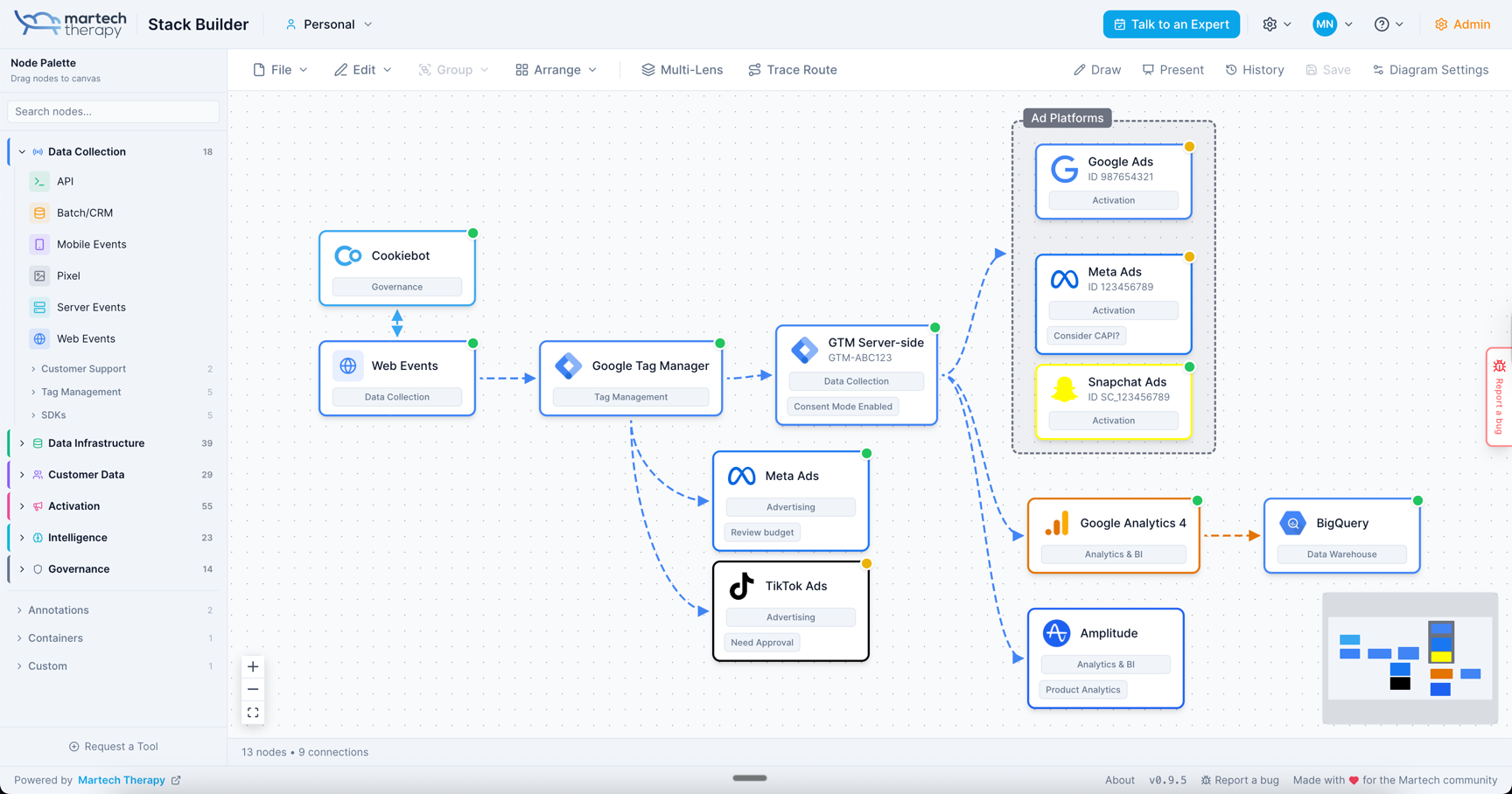
The old stack was built on a simple premise: humans do the thinking, tools do the executing. You'd think of a campaign concept, write it in one tool, design it in another, schedule it in a third, track it in a fourth, analyze it in a fifth. Each tool was a specialized instrument that required a trained operator. The stack was essentially a collection of very expensive, very complicated hammers and wrenches, each one really good at its specific job, each one requiring someone who knew how to use it.
The AI stack works differently. It collapses the thinking and the executing into the same layer. It's not a tool that waits for your instructions - it's a system that participates in the creative and strategic process itself. And this isn't some distant sci-fi scenario. It's happening in marketing teams right now.
I watched a growth marketer last week spin up an entire demand gen campaign - messaging framework, ad variations, landing page copy, email sequences, even the initial audience segmentation logic - in about ninety minutes. Not because she was using faster tools. Because she was having a conversation with Claude, iterating in real-time, pressure-testing ideas, generating variations, adapting based on what was working. The AI wasn't automating her work. It was thinking alongside her.
That's the shift that's easy to miss if you're still thinking in stack terms. The traditional stack assumed a rigid workflow: strategy, then creative, then production, then distribution, then analysis. The AI stack assumes iteration: you're doing all of those things simultaneously, in conversation, adjusting in real-time based on what you're learning.
So what does this actually look like in practice? It's not about ripping out Salesforce or HubSpot tomorrow (though you might be surprised how much of their functionality you stop using). It's about recognizing that the center of gravity is shifting. Instead of data flowing through your stack, orchestrated by humans at each step, you've got AI agents that can access your data, understand your context, make decisions, and take action - with you providing direction, judgment, and guardrails.
The AI stack has three layers, and they're simpler than what you're used to. First, your foundation - the data and the access. Your customer data, your content, your brand guidelines, your performance metrics. This needs to be accessible to AI, which means APIs and permissions, not necessarily fancy integration platforms. Second, your intelligence layer - the AI models themselves, whether that's Claude or GPT-4 or the next generation that's coming. This is where the actual work happens. And third, your interface layer - how you interact with the intelligence. Sometimes that's a chat interface. Sometimes it's embedded in your workflow tools. Sometimes it's autonomous agents doing their thing in the background.
Notice what's missing? The seventeen middleware tools that connect your email platform to your analytics platform to your content management system to your social scheduler. The AI doesn't need middleware. It can read your analytics directly, draft the email directly, publish the content directly. It's not that those platforms go away overnight - it's that they become data sources and distribution channels, not the actual workspace where marketing happens.
The marketers I see adapting fastest aren't the ones with the biggest budgets or the most sophisticated stacks. They're the ones who are willing to work differently. They're running experiments where they use AI as their primary tool and their traditional stack as backup. They're building internal prompt libraries instead of SOP documents. They're measuring cycle time instead of just campaign performance. They're hiring for AI-fluency alongside marketing expertise.
And yeah, there's risk here. The AI stack requires you to trust systems that don't work like the old tools - they're probabilistic, not deterministic. They need oversight, not just setup. They can be confidently wrong in ways that a traditional tool never could be. But the alternative - trying to out-execute competitors who are already working at AI speed with your human-bottlenecked stack - that's not a risk. That's a certainty of falling behind.
The marketing stack is dead because the premise it was built on - that tools execute while humans think - is dead. The AI stack is alive because it recognizes that the future of marketing isn't human or machine. It's human with machine, in conversation, iterating at the speed of thought instead of the speed of workflow.
You don't need to blow everything up tomorrow. But you do need to start experimenting with how marketing work gets done when AI is your co-pilot instead of your toolkit. Because your competitors already are.
What's one workflow in your stack that could become a conversation instead?